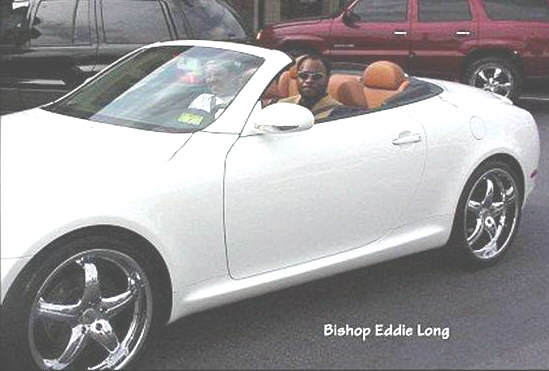
Friday, June 17, 2011
Seductive (Soft) Patriarchy and the “Problem” of Blackness
Saturday, June 11, 2011
Eddie Long, Creflo Dollar, and the Black Church’s Sanctioning of Sexual Violence
Tuesday, January 4, 2011
'Left of Black': Episode #15 featuring Pastor Carl Kenney and Zelda Lockhart
w/Mark Anthony Neal
Host and Duke University Professor Mark Anthony Neal is joined by Pastor Carl Kenney in a discussion of sex and sexuality in the Black Church, the emergence of the "Prosperity Gospel" and the Bishop Eddie Long controversy. Neal is joined by novelist Zelda Lockhart, who has been using her writing in support of HIV advocacy in Black communities. The episode was filmed on location at the Beyu Caffe in Durham, NC
Pastor Carl Kenney is the founding Pastor of Compassion Ministries in Durham, NC and former pastor at Orange Grove Missionary Baptist Church in Durham, NC, Kenney is also the author of Preacha Man and the just published sequel Backslide.
Zelda Lockhart is the author of the recently published Fifth Born II: The One Hundredth Turtle, a sequel to her first novel Fifth Born and Cold Running Creek. As the 2010 Piedmont Laureate, Lockhart has been instrumental in raising HIV/AIDS awareness in Black communities.
***
Left of Black is a weekly Webcast hosted by Mark Anthony Neal and produced in collaboration with the John Hope Franklin Center at Duke University.
Tuesday, December 21, 2010
The "Masculine Journey" of Bishop Eddie Long

By Guy Mount
In an effort to establish his “potency” via the Word of God, Bishop Eddie Long once told his congregation that it was “the job of the preacher to bring fresh sperm.” For many observers this came as no surprise, as the bishop is widely known for asserting his masculinity through these kinds of sexually-charged analogies. In the same sermon the bishop denigrated lesser preachers calling them impotent “dead sperm” disseminators and glorified a God that begets “widespread [spiritual] pregnancies.” He has subsequently made blanket statements referring to homosexuality as a form of “spiritual abortion.”
While the merging of the sacred and the profane is a centuries-old practice among African Americans, these statements have taken on an entirely new meaning in light of the current allegations made by four male church members against the bishop. The four men, in their civil lawsuits, claim that the Bishop Eddie Long induced them with lavish gifts and romantic trips in return for sexual favors and manly fellowship. The complaints essentially describe an all-male harem operating within the Bishop’s New Birth Missionary Baptist Church. Promising a “Longfellows Masculine Journey,” this now suspiciously titled “Longfellows Academy” was a youth ministry program that found the bishop allegedly ‘initiating’ young boys like a Greek aristocrat while performing elaborate cult-like marriage ceremonies between himself and his “Spiritual Sons.”
Inadvertently, the bishop may have in fact introduced some “fresh sperm” into a decades-old process that has been quietly reshaping black religious life in America. Although this particular germination was clearly not what the bishop had in mind, his case has dramatically brought issues of gender and sexuality to the center of the discussion taking place around black religious reform and spiritual leadership. While the final impact of the bishop’s plight is still unknown, it seems clear that his case will mark a significant turning point in African American religious history, especially as it relates to black sexuality and masculinity. It may also open up a much wider discussion about black religious belief in general and its intersection with contemporary cultural politics. As Syracuse University Professor Boyce Watkins wrote in a recent article for Black Voices, these allegations have the potential to “change the black church forever.”
The Performance of Religious Manhood
In the bishop’s defense, he really did do everything in his power to keep the lie alive. The extreme effort that the bishop exerted in order to demonstrate that he might single-handedly hold the cipher of black manhood was remarkable to the point of comical. His dogmatic performances continue to this day, as unlike other preachers whose private sex lives have been exposed, the bishop has decided to take the most unheard of (and masculine) of all positions; he’s fighting the charges. The elaborate pageantry was on full display in the bishop’s first public address regarding the allegations and was held on Sunday morning after the allegations broke in front of his New Birth “family.”
Beaming with charm and confidence the bishop started off by bending the truth. He told his congregation that he had waited to address the world until this moment because “[m]y first responsibility was to my family. Then my next responsibility is not to address the world before I address my family at New Birth.” This met with great applause from his congregation despite the fact that earlier in the week the bishop’s attorney appeared on the Tom Joyner show in the bishop’s steed, saying that that the bishop’s true desire was to address the world and the media first but that he, as his attorney, had to talk the bishop out of it. Where the bishop’s true desire really lies we may never know. What we do know is that the bishop vowed to fight the charges while pitting himself as David against Goliath. Continuing the analogy the bishop threatened all those who might doubt him, saying “I’ve got five rocks and I haven’t thrown one yet.” The bishop did however throw down his mic, snatched his wife, and left the stage leaving us all to wonder what he has in store for the world. Throughout the sermon Long admitted that he was not “a perfect man” and refused to deny that he had sex with other imperfect men. Although he said: “this thing, I’m gonna fight” we don’t yet know if “this thing” is a sexual orientation that he will later admit to and attempt to exorcise.
Not surprisingly, the performance met with overwhelming approval from the majority of Long’s supporters. Gabrielle A. Richards, a New Birth church member, told CNN that she “was so proud of him the way that he came out with his head high up and with his fabulous wife and he showed the strength that I’m accustomed to. And this is the Bishop Long that I know.” The bishop’s confidence and “fabulous” yet silent wife meant for Ms. Richards that their might still be hope that the nuclear black family rooted in heterosexual patriarchy might weather the storm. Ultimately it was the notion that nothing had changed which proved so comforting to her as “Bishop Long did a great job assuring us that he’s still Bishop Long.” Of course the implication was that Bishop Long could not be Bishop Long if he turns out to be the gay Bishop Long.
Others had a different assessment. The Reverend Carlton Pearson, Senior Pastor of Christ Universal Temple which openly welcomes and accepts LGBT members, commented on CNN regarding the same sermon saying that “the people rejoiced Sunday because he didn’t admit to anything. They didn’t want him to.” Apparently Bishop Long is a man who knows what his flock can handle and what they want to hear. Rev. Person, who is one of the leading advocates of the Gospel of Inclusion, told the nation prophetically that “Bishop Eddie Long is just the tip of the iceberg.” Gospel music and the black church are overflowing with LGBT members, according to Rev. Person, and without them “we wouldn’t have a church.”
Read the Full Essay @ History News Network
***
Gary Mount is a teaching assistant at San Diego State University and a HNN intern.
Monday, October 11, 2010
'Left of Black': Episode #4 featuring Shayne Lee and Treva Lindsey
Professor Lee is the author of three books including Erotic Revolutionaries: Black Women, Sexuality and Popular Culture.
Professor Lindsey's research and teaching interests include U.S. women's history, black popular culture, black feminism, critical race and gender theory, and African diaspora studies. She blogs at The Diva Feminist.
Monday, October 4, 2010
'Left of Black': Episode #3 featuring Salamishah Tillet and David Ikard
Professor Tillet is Founder of A Long Walk Home, a non-profit organization that uses art therapy and the visual and performance arts to document, to educate and to bring about social change.
Professor Ikard is the author of Breaking the Silence: Toward a Black Male Feminist Criticism.
Thursday, September 30, 2010
Chasing Jamal Parris

Chasing Jamal Parris: Did TV Station Cross The Line?
by Michel Martin
A newly surfaced television interview with Jamal Parris, the third of four men accusing Atlanta-area megachurch pastor Bishop Eddie Long of sexual coercion, is making its rounds online.
The local Fox affiliate in Atlanta, WAGA-TV, landed the "exclusive" interview after it dispatched its "Senior I-Team Reporter" Dale Russell to hunt for Parris in Colorado, where he now lives — but the city was not disclosed.
Apparently, the feverish hunt was successful.
Parris appears in the report looking as though he has been ambushed by Russell and his determined TV crew in a grocery store parking lot.
The reporter even goes as far as to admit, "Jamal Parris didn't want to talk at first, but before he left us he had plenty to say about Bishop Eddie Long."
Red the Full Essay @ Tell Me More
Tuesday, September 28, 2010
From the Belly of the Beast (New Birth Missionary Bapist Church)

by William Jelani Cobb
The cars began streaming into the parking lot at New Birth Missionary Baptist Church even before the sun had risen. On a normal Sunday church traffic chokes the off-ramps at Interstate 20, down to Bishop Eddie Long Boulevard that leads onto the grounds. This, as the news vans lining Bishop Eddie Long Boulevard attested, was not a normal Sunday.
For those who had no knowledge of Eddie Long before charges of sexual coercion were leveled at him last week it's difficult to convey Eddie Long's niche in the Atlanta ecosystem. He presides over a massive institution, with reportedly more than 25,000 members. On I-85, just north of the airport, a titanic billboard featuring Long's image greets commuters. The caption reads "Live like him, Lead like him, Love like him." The him is presumably a reference to Jesus Christ, but it's Long's image drivers see, not the Nazarene carpenter. The church campus sits on 250 acres of land in suburban Lithonia but it is inescapably linked to Atlanta's religious culture.
Long is arguably the pre-eminent black proponent of the prosperity gospel and his message of financial deliverance dovetailed neatly with Atlanta's credo of visible black success. More than a handful of his critics have seen New Birth as a counterpoint to Ebenezer Baptist, the church co-pastored by Martin Luther King, Sr. and Jr. Where King led an inner-city congregation and emphasized the biblical mandate to pursue social justice, Long's sprawling compound is miles outside Atlanta and he is more likely to exalt the possibilities of grand financial success.
Nor are the connections to MLK merely metaphorical. Bernice King, the youngest daughter of Martin and Coretta Scott King is a minister at New Birth. She and Long stirred controversy in 2004 when they led a march demanding that the legislature amend the state Constitution to forbid gay marriage - which was already illegal in Georgia. (It was particularly incendiary given that Long began the event by lighting his torch in the eternal flame at Martin Luther King's crypt.) In 2004 Long endorsed George W. Bush in all but name, charging that John Kerry would not protect the nation from the looming menace of same sex unions.
Against that history, the charges that Long coerced teenage boys in his youth foundation (ineptly dubbed the "Long Fellows") into gay sex acts detonated like a concussion grenade. On some level the homophobic pastor who is secretly engaging in gay sex is the most fatigued of clichés. But Long's allegations differ if for no other reason than the scale. It also has to be mentioned that the black church had perfected its own version of Don't Ask, Don't Tell long before the military dreamed of such a compact.
Read the Full Essay @ The Atlantic
Saturday, September 25, 2010
NBM Saturday Edition:(Not) About Eddie Long: BlackQueerness and Social Life

(Not) About Eddie Long: BlackQueerness and Social Life
by Ashon Crawley
Queerness (always already a concept in and of blackness) once and again comes down on us, befalls us, befuddles us. Queerness rears its ugly head, showing itself, laying bare the necessity of the hypothetical and hypocritical in any theology, BlackChristianity notwithstanding. The general question: why are we all up in arms regarding the (al)legibility of the potentiality of queerness in BlackChristianity once again? I am not interested in Eddie Long in his particularity as much as I am intrigued by what his seeming infractions – and the many responses to it – speak about notions of sexuality, religious tradition and the structured life of BlackQueer folks. I want to make a few general observations, possible because of my obsession with the words of Hortense Spillers, Toni Morrison and Fred Moten. These three, in my understanding, engage projects that ask how thought and imagination – of gender and sexuality for Spillers (see “Mama’s Baby, Papa’s Maybe: An American Grammar Book”); of literature and narrativity for Morrison (see Playing in the Dark: Whiteness and the Literary Imagination); of the western philosophical tradition for Moten (see “Knowledge of Freedom”) – are always troubled by a pathogen that needs be detected, diagnosed and discarded.
So I want to here make a claim that there is an irreducible erotics at the heart of Christianity generally, certainly in the western formation of Protestantism with its focus on and targeting of the body’s behaviors and comportments, even moreso true for articulations of Christianity in Black(ness). This erotics is that which continually is in need of control, in need of policing, in need of curtailment. In Aberrations in Black: Toward a Queer of Color Critique, Roderick Ferguson convincingly argues that the Black Holiness/Pentecostal church targets the body of individuals as that which needs to literally behave itself. This behaving of oneself is always done through the control of the libidinal excesses, through a rhetorics against eroticism. Evelyn Brooks-Higginbotham in Righteous Discontent elucidates how the politics of respectability was likewise used to target and curtail the seeming loose behaviors of Black Folks as a means to citizenship and Christian formation. One may begin to think about the relationship between notions of self-control that Black Protestantism can be said to aspire and reckless abandon that BlackQueer folks may be thought to embody and perform. BlackQueer folks are the performative vestibularity (Spillers’s word) of the particular Black Church context in which I am interested. BlackQueer folks in this religiocultural context come to stand in for everything that the one who is “saved, sanctified and filled with the holy ghost” is not. Joseph Roach might say that BlackQueer folks, though marginalized and placed on the outside, are central to the faith tenets of this particularly raced, sexed, religious context.
This is a longwinded argument regarding the necessity of proximity of a certain BlackQueerness to any articulation of BlackChristianity. Supposedly, being saved, sanctified and filled with the holy ghost is everything BlackQueerness is not. But BlackQueer folk are necessary in church buildings and in mental imaginations as targets of hatred that is nothing other than residue of the patriarchal, sexist, racist, classist society in which we all live, move and have our being. BlackQueer folks, then, must occupy space of choir lofts and the prepared notes of preachers if any of that preaching is to be effective…so it seems. I am convinced that BlackQueerness, as a sensual, sensuous field, is the libidinal, excessive, always already out of control, in need of control, philosophy that preachers write and orate against. Or, more precisely (hopefully), there is an intense and fundamental relationship between the desire for respectability, citizenship and salvation on the one hand with the BlackQueer figure on the other. This BlackQueer figure figures its way into sermons and songs by way of denial (outright, overwrought, write out, wrought over), by glances, by stares, by rumor, by gossip, by condemnation, by celebration (we sing and play the organ very, very well!).
If this is the case – and certainly, Eddie Long might agree with my sentiment of the some purported sinfulness of BlackQueer folks as he has in times past, taking firm stances for the family and against marriage equality – BlackQueerness is a sort of pathogen that exists previous to declarations of salvation; we might even say it is the force that animates BlackChristian formation. Some call it sin. I call it a particular enjoyment and pleasure of erotics that is foundational for life and love that was the condition of possibility for abolition movement, for modes of flight and escape, for what we call freedom. (And I don’t want to be “saved” from that…and I doubt you do either. So the quest of BlackChristianity since enslavement has been to figure out a way to assert desires freedom while somehow striving toward American citizenship – recognition by the state.) Normative BlackChristianity (so intimately related to the Christianity of its origin, though this is not my concern here) suppresses its anoriginal BlackQueerness by recognition, relegation and removal. This removal only a ruse.
Many are astonished by such allegations. Astonishment – given when folks say “I can’t believe it!” or “Let’s pray for him!” or “This can’t be true!” – is the articulation of the betrayal of knowledge by stupefied senses. The etymology of “astonish” is “to stun, to daze, deafen, astound.” The senses – of sight, smell, taste, touch, sound – are cut, augmented by some seemingly new knowledge that, we know, isn’t too new at all. The senses are stunned by the knowledge of BlackQueer folks existing and having social life in the face and place of impossibility. It’s like how Harriet Tubman escaped slavery, arrived to New York only to find herself alone. She then stole her body back to the very place she left in order to bring others with her. There was a desire for and movement toward sociality that animated her notion of joy and happiness, what we call freedom.
This elucidates my concern for how BlackQueerness – in the space of the religious circle that seeks, but is also predicated upon, its exclusion – astonishes by the alleged and the legible. Some folks simply don’t want to believe that a person like Long could even engage in such activities because the activities are supposedly reprehensible. Because of the position of power he occupies, and by way of the rhetoric he utilizes against BlackQueer folks, the putting to question of Long is put to question. Or, how can one allege that he is even allegible? For many, Long and others like him do not even inhabit the zone of the alleged because of money, power, respect is a covering and mode of escape. The concern here, I think is this: what does it mean that a type of BlackQueerness can make even the most successful, blessed, prosperous (and those all should've been in scare-quotes) man succumb, acquiesce, fall? This isn't about him. It's about the notion that he has all these material objects/possessions that should have been able to "protect" him from such penetrations (and I mean that in many resonances, whether or not any of the alleged sex acts were indeed penetrative). We live in a society of possession and he preaches prosperity through possession. Yet, none of that could protect his libidinal borders.
This isn't about him. It's about those of us who don't have these possessions. How ever will we “protect” ourselves? The media harps on the innocence of the accusers and the church speaks about the possessions they lacked (e.g., they were poor kids, broke into the church, tried to steal possessions). The media and church also speak about Long in terms of material possession, his wife and children included. He has attained this stuff, so these intimate zones of contact, these desires for companionship seem contradictory at best, scary at worst. Salient is the relationship between possession of stuff (capitalism) and modes of expected socialsexual behavior. We gotta rethink what it means to be a sexual being. We gotta be attentive to how capitalism works with and against modes of religious desire. As such, allegibility, in my estimation, is a concern for the possibilities to think through and against modes of power, of authority, of religious or embodied text. If we can allege Long, religious tradition is ledged, place on the sill about to topple over and break. To put to question the very questions is to think about alleging as a condition of possibility for new modes of existence that do not depend upon suppression and relegation, but rather openness celebration.
More intriguing for me, though, is the notion of legibility, the possibilities for discernment. There is a social life occurring underground, outside, beneath the surface. It’s that open secret that everyone suspects but few respect. Who has this knowledge, this discernment? Astonishment comes by way of the kind of social life – men (and more expansively, all gendered folks) laughing, loving, sexing, hugging, enjoying each other’s company – inhabiting the homophobic zone of BlackChristianity makes possible. To steal a question from Moten for my own purpose: “what if desire is correspondent to a certain kind of event to which a certain set of social conditions make possible?” I want to displace the question of Long’s particularity, of his alleged acts to ask, rather, what are the social conditions in which he (and his accusers, and many, many others in similar positions) have desire?
Being set on the outside of any institution does not mean that life simply goes away, that folks don’t have relationships, don’t want to love. It means that they (we) find ways to do it in the space of impossible conditions. This is not to claim that it’s cool for Long to be homophobic, an abuser of power or boys. But to step aside from that question, I ask what sorts of possibilities for life exist for those who have been and continually are constrained, compressed? The sort that is alleged regarding Long is certainly one possibility. But there are others as well: where having a coke with a lover in the public square can become an occasion fo poetry; where the secret smiles and winks and nods body forth love. I am interested in what the social conditions for desire to be enacted are. The possibility of a BlackQueer social life – not merely as supplement but constitutive – in the face of BlackChristianity’s very denial of this social life allows us to be attentive to how desire for relationship, for sociality, is a spiritual thing.
And…
watch this, watch this, watch this
...someone should preach about that.
***
Ashon Crawley is a graduate student in the department of English at Duke University.
Thursday, September 23, 2010
Commentary: Why Rev. Long's Sexuality Isn't the Point

by Saida Grundy
This week we were actually not surprised at all to learn that another "mega-church" preacher was accused of doing in his private life the exact thing he threatens hellfire against from the pulpit.
The consistent deluge of moral hypocrisy from evangelist clergymen has them running neck and neck with GOP elected officials in the "Who-can-hate-the-most-in-others-what-they-actually-do-themselves" 4x4 relay race...
Which brings us to metropolitan Atlanta. Two Georgia men have alleged that Eddie Long*, pastor of 25,000-member New Birth Missionary Baptist Church, coerced them into sexual acts that began when both were teenagers. The salacious details of the case unfold like birthday gifts to "The Boondocks" writing team. None of the checklist items of career-ending sex scandal are spared here. The plaintiffs separately filed complaints that accuse Long of exploiting his spiritual authority over them in order to solicit sexual acts in exchange for lavish gifts, trips, cars and electronics.
I have always considered public allegations against sham moral leadership to be good wholesome family fun, and for the moment, we are all entitled to be swept up in the licentious hoopla of it all. But to stop short of understanding what should be our real problem with Long's message and politics only baits our own homophobia. This is not Eddie Long's fall from grace, for he never should have been in our good graces. Let us consider that the Reverend's most serious offenses against our conscience were committed proudly in broad daylight.
Read the Full Essay @ Essence.com
***
Saida Grundy is a doctoral candidate in the Department of Sociology at the University of Michigan at Ann Arbor.
Eddie Long Case Should Mark the End of Black Church Homophobia

Bishop Eddie Long, megachurch pastor and prosperity purveyor, has now been named in three separate lawsuits alleging sexual coercion of two young men in Atlanta, Georgia. Bishop Long, in the words of the Southern Poverty Law Center, “is one of the most virulently homophobic black leaders in the religiously based anti-gay movement.”
Like the formerly-closeted Ken Mehlman, who recently repented for his work to prevent gay marriage, these lawsuits, if substantiated, would suggest that Long’s homophobia began with his own self-loathing.
What is especially disturbing about this story is the manner in which Long is alleged to have lured young men on trips and sexual encounters. Calling the plaintiffs his “spiritual sons,” the lawsuit states that Long used various rituals in a ceremony to “seal” his “sons”—including candles, exchange of jewelry, and discussion of biblical verses that reinforce the spiritual and God-like connection between himself and the young man.
Isn’t this the man who marched with Bernice King alongside five thousand African Americans against gay marriage? As Sarah Posner points out here on RD, this practice of manipulating congregants into sexual relationships stems from “kingdom now” relational theology, mandating close relationships with spiritual leaders or “spiritual parents” in an individual’s life.
Conveniently, Long’s Longfellows Youth Academy was a place where young black men could be “trained to love, live and lead,” with Long and others acting as “spiritual parents.” Though they appear to have been taken down the website had included testimonials such as: “My real journey to Manhood didn’t start until I joined Longfellows.”
Another testimonial powerpoint outlined how the Ishman masculine journey and Bishop Long’s teachings about the bloodline stated that their “bloodlines should not be destroyed” and that “we have to take care of our bloodline because if we don’t, we are not doing our jobs as men.” With the revelations of sexual activity and the link of one of the plaintiffs to the academy, the academy is being sued, along with New Birth church as a corporation.
However, that’s only part of the story. Sex scandals happen everyday in church because leaders and members of strict churches can’t uphold the high standards of living they promote, aspire to, and harangue people over. The endless carousel of revelations about the Catholic Church worldwide is exhibit A of that broken message. In that sense, there is nothing new here.
The real story however, is that this case explodes the cover of the black church’s internal don’t ask, don’t tell policy which has had a profound effect on the community and its followers. It’s very interesting that the Long scandal broke almost immediately after black pastors led by Bishop Harry Jackson came together with the Family Research Council to oppose the repeal of the Don’t Ask, Don’t Tell Act. Many black pastors have staked their entire ministries on the “family” and the obsession with mainstream gender norms that encourage heterosexual marriage, abstinence, and patriarchal norms. It is an all-encompassing message that is obsessed with the suppression of sexuality in black churches, mega-churches and storefronts alike.
Read the Full Essay @ Religion Dispatches
***
Anthea Butler is associate professor of religion at the University of Pennsylvania. Her most recent book is Women in the Church of God in Christ: Making A Sanctified World (UNC Press, 2007)
Friday, February 10, 2006
Homophobia and The Civil Rights Movement? MLK Jr's Legacy is Up for Grabs

***
Or, Tomb-Raiding and the Legacy of Civil Rights
by Erica Edwards
On December 11, 2004, an estimated 25,000 people participated in a march called “Reigniting the Legacy,” a procession from Atlanta’s Martin Luther King Center for Non-Violent Social Change to the city’s Turner Field in support of a constitutional amendment banning same-sex marriage. The story of this march, led by Bishop Eddie Long, the pastor of a mega-church outside of Atlanta, and Bernice King, the youngest daughter of Martin Luther King, Jr. and an elder in the church, illustrates how the charismatic political aesthetic is put to use to police African American sexuality, to align black religious groups with the ‘family’ or ‘moral values’ agenda of the right, and to keep ideas of manhood tied to or tangled up with a model of religious and political leadership that relies on unyielding categories of sexuality and gender.
Charisma, most clearly defined by the sociologist Max Weber, refers to “a certain quality of an individual personality by virtue of which [a leader] is set apart from ordinary men and treated as endowed with supernatural, superhuman, or at least specifically exceptional powers or qualities.” In the political context, it is a mixture of sacred and secular impulses—it is a structure of group relationship centering around one exceptional man (usually) perceived to be gifted with a privileged connection to God. This individual’s right to rule is always held to be the function of divine ordination. For Weber, charisma represents a revolutionary force that opposes old, sedimented forms of rule. Notwithstanding the potential of charisma to ‘do a new thing,’ I want to question this identification of charisma with the new and examine its implementation of a revolutionary conservatism, a radical return to an older, putatively stable order. What I’m calling the charismatic aesthetic here is the assemblage of performative and symbolic elements that produce the charismatic scene, things like spectacular oratory, the masculine (or masculinized) body, and the positioning of the leader in front of or above his followers.
For black Americans, charisma as a form of political authority has become an organizing myth for ideas of political mobilization. While social historians have distanced their scholarship from “Great Man” theories of history, the history of black social movements as the byproduct of charismatic leadership continue to circulate widely in popular culture. Clayborne Carson’s essay on Martin Luther King’s charisma suggests that in popular civil rights history, “a Great Man is seen as the decisive factor in the process of social change, and the unique qualities of a leader are used to explain major historical events” (Carson 448). The leader is history’s indispensable protagonist: without him, history (what is believed to have happened) and historical narrative (what is said to have happened) are impossible. Carson goes on to suggest that King has functioned as the necessary protagonist in the public narrative of civil rights and is seen as the exemplary political spokesperson and miraculous history-maker. He embodies, for post-civil rights black culture, the quintessential charismatic leader and Great Man—the king, as it were, of black history and black politics.
King’s role as charismatic exemplar was at the center of the “Reigniting the Legacy” march’s claim to social authority. The use of the King Memorial as the starting place at which the leader lit a torch from the memorial’s eternal flame, the circulation of King’s rhetoric in quotes included in publicity and speeches, and the location of the march in King’s childhood home, Atlanta’s Sweet Auburn neighborhood, all exemplify the organizers’ deliberate alignment with the cultural memory of King. The march made a bold investment in the political capital associated with King’s idealized status in the nation’s imagination.
The march’s goal was reportedly to “get back into the conversation of the nation,” to introduce black Christians as vocal participants in the national discourse on marriage and sexuality. Quoting King’s warning against the “appalling silence of good people,” the march’s publicity describes its goal as the “protection of marriage,” including “strategic policy direction for a constitutional amendment to fully protect marriage between one man and one woman.” The march being framed, ironically enough, as a coming out story, participants in news photographs wear shirts reading “Stop the Silence” and the event is touted in news stories as an opportunity to speak in “one voice,” to articulate “a unified vision of righteousness and justice.” In a moment less than a month after voters in 11 U.S. states, including Georgia, approved of state constitutional bans on same-sex marriage and in a state that had passed a Defense of Marriage Act nine years prior to the march, the march’s leader, ostensibly alarmed by the suppression of anti-homosexual sentiment, told reporters, “This is our coming out day. We are here to stay and will be heard.” Passing a counter-demonstration of 50 gay rights activists, the march proceeded from the King Center to Turner field, where a recorded speech by Bishop Long played over the loudspeakers to greet the marchers entering the stadium. In her introduction to Long, Bernice King said, “I believe this day will go down in the history books as the greatest showing of Christ and his kingdom in this century” and designated Long “the prophet appointed by God to speak the mind, heart, and gospel of God.”
The march’s primary message was a call to crystallize rigid categories of sexual and gender identity, to buttress conservative family values in the name of historical ‘legacy’ and civil rights. As a literary critic, I’m as concerned with the form of the march—its architecture—as I am with its content or message. I’d like to draw our attention to the aesthetics of this religious, political event, that is, to the various symbolic ingredients that produce the performance of charismatic authority. To raise the question of the aesthetic is to ask: What makes a thing good, true and beautiful; what makes it appeal to the senses? Charismatic authority is, at its heart, is a question of aesthetic value: Ann Ruth Willner’s extensive research on the subject suggests that “it is not what the leader is but what people see the leader as that counts in generating the charismatic relationship” (Willner 15). Charisma is constituted by a cycle or dynamic of perception and performance, a relay of symbols between leaders, followers, and observers.
As far as I can gauge by journalists’ reports, The “Reigniting the Legacy” march made use of at least four powerful symbols in its production of the charismatic scene. First, the site of departure, King’s burial site, indexed a primal source of mourning for African American leadership. The march tapped into what Willner calls “postmortem charismatic authority,” authorizing its social claims by making the memory of King do necessary political work in the present. Indeed the march can be read as a tomb-raiding mission that dug up the remains of King’s authority for its own use, hence Keith Boykin’s assessment that the march “hijacked” King’s dream. The fact that the march was a raising of the dead dressed up as a ritual of mourning was shored up by the all-black attire of the majority of the marchers.
Next, Bishop Long’s own physical presence added to the symbolic tying of charismatic authority to the male body. The domain of charismatic authority, particularly in the civil rights tradition, is most often a masculinist sphere of influence—Steve Estes suggests as much in his recent book on manhood and civil rights when he argues that the masculinist rhetoric of political speakers “rallies supporters by urging them to be manly or to support traditional ideas of manhood” (Estes 12). In this instance, charismatic performance—the acting out of a privileged connection to the divine—plays out as a bourgeois, heteronormative family romance: Bernice King gestures to Long as her deceased father’s substitute and successor, and in the drama, Bishop Long plays father not only to her but to all. As much at is purported to “reignite” the legacy of civil rights, the march represented an Oedipal performance that demanded the slaying of King’s dream of egalitarian social life and the coronation of Bishop Long as father figure or new king for the race. The public family drama fortified the march’s homophobic appeal to the union between one man and one woman as the prime marker of “righteousness” and “justice.”
Finally, the torch and the march forward, like the tomb and the bishop’s physical positioning, functioned symbolically to attach charismatic leadership to a rigid, masculinist, heterosexist conception of black Christian identity. The torch is a common emblem of enlightenment and tradition that signifies the transferability of power—the Olympic torch, for example, is carried along from one location to the next to signify the passing on of unquestioned eternal values (like unity and tolerance). In this scene, King’s power is kept alive eternally in the memorial flame; Long accesses it in order to possess King’s authority. The march, in the end, ignited the bishop’s own power, his position as new spokesperson for the ‘good people.’ Further, the historical function of the march for blacks in America, Eddie Glaude has suggested, is to perform or “to continuously retell the story of bondage, the march toward liberation, and the discipline necessary to remain free.” The torch confers the power to free and to discipline, to liberate and to police the criteria for living freedom out.
A strange mixture of funeral procession, soldier march, Olympic opening ceremony, worship service and political rally, the “Reigniting the Legacy” march placed charismatic authority on center stage. It showed how charismatic leadership, often masking itself as a ‘natural’ expression of black religiosity and political consciousness, actually produces itself through self-conscious performances of authority that are tied to a narrow, patriarchal and homophobic conception of manhood. The question, perhaps, for those of us interested in engaging the church in a radical critique of heteronormative masculinity is: is charismatic authority an acceptable means or the only basis for the creation of an egalitarian religious body? If Kelly Brown Douglas is correct that “the change in attitude toward sexuality within the Black church and wider community must begin not at the top with Black church leadership…but at the bottom with the people who sit in the pews,” it also seems right to call into question of the church’s social architecture and what appears to be a patriarchal investment in the metaphysical distinction between leaders and followers.
***
Professor Edwards specializes in African American literature, gender studies, and black political culture. She is currently at work on a book project under the working title Contesting Charisma: Fictions of Political Leadership in Contemporary African American Culture (forthcoming in 2011 on the University of Minnesota Press). Her work, published in Women & Performance, Callaloo, American Literary History, and Transforming Anthropology, shows how contemporary African American literature challenges us to think in new ways about the relationships between African American narrative, American popular culture, and the contemporary history of black politics and black social movements.