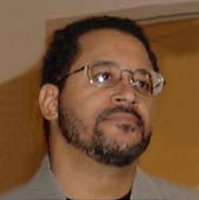
"Four Movements and a Coda" was intially published at Popmatters.com shortly after the 9/11 attacks. Five years later, I am struck by how much my thinking about the attacks and the issue of terrorism--including State terror--has not radically changed.
***
Four Movements and a Coda: Perspectives on a National Tragedy
[with a nod to Amiri Baraka (Leroi Jones)]
by Mark Anthony Neal
It was the usual beginning of my day. Sitting at Starbucks, sipping an Americano, reading Danzy Senna's Caucasia, eagerly awaiting my first listen of an advance copy of Macy Gray's Id -- as usual as the beginnings of the thousands of folks who would normally populate New York City's World Trade Center Towers. My wife called via cell phone to check in and in passing mentioned that a plane hit one of the towers. I went back to work. In a later call she confirmed that both towers had been hit in an apparent terrorist attack.
A young woman, also on a cell phone, asked if I had also been just informed of the drama. It struck me that cell phone technology had truly changed the world. Only hours later would most of the nation truly understand how dramatically important the privilege of owning a cell phone would be. Within minutes I was in the car headed for my office, hoping to get more information from my campus computer. On the car radio I listened to the audio broadcast of Peter Jennings on ABC News. I was barely out of the parking lot when I heard that the second tower had fallen. For the rest of my life I will remember the pain, reservation, and despair in Jennings' voice. His emotions reminded me of the broadcasts of the late ABC anchor Frank Reynolds, in the aftermath of the Reagan assassination attempt in 1981. It would be hours later before I would sit in front of the television and get detailed visuals of the attacks, but none of the various visual narratives moved me in the way that Jennings' audio narration did earlier in the day.
After three days of looping visuals, interchangeable talking heads, sloganistic banners like, "America Under Attack", and scrawling print, it has struck me that Americans had been thoroughly sensitized and even prepared for the inevitability of such an attack. Movies like The Seige, starring Annette Bening and Denzel Washington, introduced Americans to the concept of terrorist "cells", the CIA's collusion with such organizations, and the possibility of martial law in American cities. Independence Day made the logic of the attacks—at least in the symbols that were chosen—seem more clear. Also, the recurring images of the plane crashes and collapse of the buildings and the fires at the Pentagon recalled the looping visuals of Reagan's shooting 20 years ago. This style of news presentation was parodied in Saturday Night Live's "Buck Wheat", a skit on the attempted assassination of President Reagan. As I and so many Americans have remained glued to our televisions the last few days, it has struck me that there is no "new" information; there is only the consistent rehashing of the already known, and a repetitive reminder of what is unknown.
* * *
With the exception of network and local news reporters, I can only recall two or three black faces on TV during this ordeal; an African-American man described as a former commercial pilot, Colin Powell, and Harlem Congressman Charles Rangel. In their book, The Black Image in the White Mind: Media and Race in America, Andrew Rojecki and Robert Entman suggest that black commentators are rarely used to comment on national and international issues unless they are specifically related to issues of Race. The next day I would hear a steady flow of black commentators on the Tom Joyner in the Morning Show: former UN ambassador Andrew Young, Congresswoman Maxine Waters, and Jesse Jackson would all appear on the program within a one-hour span.
Though the show leaves a lot to be desired and falls short in many areas, its power as the "digitized chitlin' circuit" for the black masses was never more apparent than during the days following the attack. The Tom Joyner in the Morning Show in many ways recalls the powerful role of the independent black press throughout the 20th century. It was in the pages of press organs such as The Pittsburgh Courier, and The Chicago Defender, and magazines like The Crisis (under Du Bois's leadership) and Opportunity that black intellectuals and commentators measured the rising tide of radical American nationalism against the realities of labor exploitation, poverty, racism, and fundamental social inequities. Though we are far removed from the "Double-V" campaigns of World War II, where African-Americans hoped for victories at home and abroad—and Tom Joyner in the Morning is far from an independent voice in the media -- it is important to remember that various racial and ethnic groups experience America is very different ways, even as we are all affected and challenged by the tragedies of September 11th.
* * *
Among a host of artists who have recently gravitated to political rap, including Dead Prez, Black Star (Mos Def and Talib Kweli) and Mystic, The Coup remains one of the most politically sophisticated acts to emerge in the last decade or so. The group's three releases, Kill My Landlord (1993), Genocide & Juice (1994) and Steal This Album (1998) feature decidedly anti-capitalist tracks like "Fat Cats, Bigga Fish" and "Kill My Landlord". Their forthcoming release, Party Music, was set to drop in November, but the group was recently thrust into the spotlight because of the project's cover art. The artwork, which was done two months ago, prophetically captures a bomb explosion at the top of the World Trade Towers; primary lyricist Boots Riley is shown doing the deed by flicking the remote control. The image of the cover art was pulled from their label's website (Ark 75) within hours after the actual attacks.
Coincidences aside, the cover art on Party Music raises the question as to why two hip-hop artists would see the metaphorical collapsing of the World Trade Towers as symbolically important. Few in "the hood" have read Gramsci, and likely fewer have ever heard the word "hegemony". But clearly many of these people — forced to struggle day-to-day in a capitalist society where the profit margins of shareholders are often deemed more important than the health benefits of they who guarantee such margins with their own labor — would find value in such a symbolic gesture. In this regard, Americans must also ask why apparent terrorists would find value in destroying such icons of a thriving capitalist society as well as the lives that labored within them. The idea that these suspected terrorists — who some deemed "freedom fighters" just two decades ago — are now enemies of Democracy is an insult to the intelligence of the American public.
As the father of a young daughter, I am often faced with the task of disciplining her. When I do, without fail she will run to my wife and announce that I had punished her, to which my wife responds, "Well what did you do to make daddy discipline you?" It would do the American public well to ask such simple questions of its leadership.
* * *
No doubt in the days prior to the attack there were a significant amount of "hip hop heads" preparing to mark the fifth anniversary of the death of Tupac Shakur. The prophetic nature of Tupac's Mackevelli recording, which seemed to foretell his death, has led to the on-going belief among some that the late hip hop artists is still alive. Many of these same hip hop heads were probably unaware of the "symmetry of violence" that the attack on the twin towers represented as the week of September 11th also marked the 30th anniversary of the slaughter at Attica State Prison in September of 1971. On that date, a multi-racial collective of prisoners had taken over the prison to protest its inhumane conditions. Over thirty people were killed, including eight New York State Correction officers. Though the yard of the prison represented a legitimate crime scene, in the days after the prison was retaken, the yard was bulldozed, effectively destroying the crime scene.
One can only hope that U.S. response to the September 11th attacks is not as haphazard as those of the Attica State Prison protest 30 years ago, when New York Governor Nelson Rockefeller and the NewYork State Troopers indiscriminately shot at people in the prison's courtyard. A measured, thoughtful, and cautious response is the very least that this country's leadership owes the victims and their families of these unprecedented tragedies.
Coda
We spent the weekend after the attack in the Catskill mountains, on a trip that we had planned months ago. This trip allowed us to insulate our young daughter from the unfolding dramas. During the our stay we participated in a late night prayer vigil which allowed me my first opportunity to really mourn those who died on September 11th. Though we are usually some of the few African-American faces on these twice yearly sojourns, we fit comfortably in with a crowd of folks who were also impacted by the recent events. As I dutifully followed the crowd in a rousing rendition of the Star Spangled Banner (which I hadn't sung in close to 15 years) and listened intently, though bemused, at Lee Greenwood's "God Bless the USA", the event ended with chants of "USA, USA". At best, this made me uncomfortable. Hearing that chant was a reminder that for some Americans the sight of waving American flags has rarely been inviting, if only because many of the folks who display these flags have been less than inviting to those who can not easily be identified as "quintessential" Americans.
I have been deeply conflicted by the events of the last week and the prayer vigil allowed me to finally understand that mourning the dead and valorizing American imperialism are two radically different concepts. The differences in these concepts will, unfortunately be will lost on some Americans.
[with a nod to Amiri Baraka (Leroi Jones)]
by Mark Anthony Neal
It was the usual beginning of my day. Sitting at Starbucks, sipping an Americano, reading Danzy Senna's Caucasia, eagerly awaiting my first listen of an advance copy of Macy Gray's Id -- as usual as the beginnings of the thousands of folks who would normally populate New York City's World Trade Center Towers. My wife called via cell phone to check in and in passing mentioned that a plane hit one of the towers. I went back to work. In a later call she confirmed that both towers had been hit in an apparent terrorist attack.
A young woman, also on a cell phone, asked if I had also been just informed of the drama. It struck me that cell phone technology had truly changed the world. Only hours later would most of the nation truly understand how dramatically important the privilege of owning a cell phone would be. Within minutes I was in the car headed for my office, hoping to get more information from my campus computer. On the car radio I listened to the audio broadcast of Peter Jennings on ABC News. I was barely out of the parking lot when I heard that the second tower had fallen. For the rest of my life I will remember the pain, reservation, and despair in Jennings' voice. His emotions reminded me of the broadcasts of the late ABC anchor Frank Reynolds, in the aftermath of the Reagan assassination attempt in 1981. It would be hours later before I would sit in front of the television and get detailed visuals of the attacks, but none of the various visual narratives moved me in the way that Jennings' audio narration did earlier in the day.
After three days of looping visuals, interchangeable talking heads, sloganistic banners like, "America Under Attack", and scrawling print, it has struck me that Americans had been thoroughly sensitized and even prepared for the inevitability of such an attack. Movies like The Seige, starring Annette Bening and Denzel Washington, introduced Americans to the concept of terrorist "cells", the CIA's collusion with such organizations, and the possibility of martial law in American cities. Independence Day made the logic of the attacks—at least in the symbols that were chosen—seem more clear. Also, the recurring images of the plane crashes and collapse of the buildings and the fires at the Pentagon recalled the looping visuals of Reagan's shooting 20 years ago. This style of news presentation was parodied in Saturday Night Live's "Buck Wheat", a skit on the attempted assassination of President Reagan. As I and so many Americans have remained glued to our televisions the last few days, it has struck me that there is no "new" information; there is only the consistent rehashing of the already known, and a repetitive reminder of what is unknown.
* * *
With the exception of network and local news reporters, I can only recall two or three black faces on TV during this ordeal; an African-American man described as a former commercial pilot, Colin Powell, and Harlem Congressman Charles Rangel. In their book, The Black Image in the White Mind: Media and Race in America, Andrew Rojecki and Robert Entman suggest that black commentators are rarely used to comment on national and international issues unless they are specifically related to issues of Race. The next day I would hear a steady flow of black commentators on the Tom Joyner in the Morning Show: former UN ambassador Andrew Young, Congresswoman Maxine Waters, and Jesse Jackson would all appear on the program within a one-hour span.
Though the show leaves a lot to be desired and falls short in many areas, its power as the "digitized chitlin' circuit" for the black masses was never more apparent than during the days following the attack. The Tom Joyner in the Morning Show in many ways recalls the powerful role of the independent black press throughout the 20th century. It was in the pages of press organs such as The Pittsburgh Courier, and The Chicago Defender, and magazines like The Crisis (under Du Bois's leadership) and Opportunity that black intellectuals and commentators measured the rising tide of radical American nationalism against the realities of labor exploitation, poverty, racism, and fundamental social inequities. Though we are far removed from the "Double-V" campaigns of World War II, where African-Americans hoped for victories at home and abroad—and Tom Joyner in the Morning is far from an independent voice in the media -- it is important to remember that various racial and ethnic groups experience America is very different ways, even as we are all affected and challenged by the tragedies of September 11th.
* * *
Among a host of artists who have recently gravitated to political rap, including Dead Prez, Black Star (Mos Def and Talib Kweli) and Mystic, The Coup remains one of the most politically sophisticated acts to emerge in the last decade or so. The group's three releases, Kill My Landlord (1993), Genocide & Juice (1994) and Steal This Album (1998) feature decidedly anti-capitalist tracks like "Fat Cats, Bigga Fish" and "Kill My Landlord". Their forthcoming release, Party Music, was set to drop in November, but the group was recently thrust into the spotlight because of the project's cover art. The artwork, which was done two months ago, prophetically captures a bomb explosion at the top of the World Trade Towers; primary lyricist Boots Riley is shown doing the deed by flicking the remote control. The image of the cover art was pulled from their label's website (Ark 75) within hours after the actual attacks.
Coincidences aside, the cover art on Party Music raises the question as to why two hip-hop artists would see the metaphorical collapsing of the World Trade Towers as symbolically important. Few in "the hood" have read Gramsci, and likely fewer have ever heard the word "hegemony". But clearly many of these people — forced to struggle day-to-day in a capitalist society where the profit margins of shareholders are often deemed more important than the health benefits of they who guarantee such margins with their own labor — would find value in such a symbolic gesture. In this regard, Americans must also ask why apparent terrorists would find value in destroying such icons of a thriving capitalist society as well as the lives that labored within them. The idea that these suspected terrorists — who some deemed "freedom fighters" just two decades ago — are now enemies of Democracy is an insult to the intelligence of the American public.
As the father of a young daughter, I am often faced with the task of disciplining her. When I do, without fail she will run to my wife and announce that I had punished her, to which my wife responds, "Well what did you do to make daddy discipline you?" It would do the American public well to ask such simple questions of its leadership.
* * *
No doubt in the days prior to the attack there were a significant amount of "hip hop heads" preparing to mark the fifth anniversary of the death of Tupac Shakur. The prophetic nature of Tupac's Mackevelli recording, which seemed to foretell his death, has led to the on-going belief among some that the late hip hop artists is still alive. Many of these same hip hop heads were probably unaware of the "symmetry of violence" that the attack on the twin towers represented as the week of September 11th also marked the 30th anniversary of the slaughter at Attica State Prison in September of 1971. On that date, a multi-racial collective of prisoners had taken over the prison to protest its inhumane conditions. Over thirty people were killed, including eight New York State Correction officers. Though the yard of the prison represented a legitimate crime scene, in the days after the prison was retaken, the yard was bulldozed, effectively destroying the crime scene.
One can only hope that U.S. response to the September 11th attacks is not as haphazard as those of the Attica State Prison protest 30 years ago, when New York Governor Nelson Rockefeller and the NewYork State Troopers indiscriminately shot at people in the prison's courtyard. A measured, thoughtful, and cautious response is the very least that this country's leadership owes the victims and their families of these unprecedented tragedies.
Coda
We spent the weekend after the attack in the Catskill mountains, on a trip that we had planned months ago. This trip allowed us to insulate our young daughter from the unfolding dramas. During the our stay we participated in a late night prayer vigil which allowed me my first opportunity to really mourn those who died on September 11th. Though we are usually some of the few African-American faces on these twice yearly sojourns, we fit comfortably in with a crowd of folks who were also impacted by the recent events. As I dutifully followed the crowd in a rousing rendition of the Star Spangled Banner (which I hadn't sung in close to 15 years) and listened intently, though bemused, at Lee Greenwood's "God Bless the USA", the event ended with chants of "USA, USA". At best, this made me uncomfortable. Hearing that chant was a reminder that for some Americans the sight of waving American flags has rarely been inviting, if only because many of the folks who display these flags have been less than inviting to those who can not easily be identified as "quintessential" Americans.
I have been deeply conflicted by the events of the last week and the prayer vigil allowed me to finally understand that mourning the dead and valorizing American imperialism are two radically different concepts. The differences in these concepts will, unfortunately be will lost on some Americans.