Tuesday, June 6, 2006

Billy Preston Goes Home

Growing up in New York City in the 1970s and listening to the classic top-pop 40 station WABC-AM, I was exposed to the great hits of Billy Preston. Tracks like "Outta Space", "Will It Go Round in Circles", "Space Race" and especially "Nothing from Nothing" were part of the soundtrack of my childhood. At the time I was oblivious to Preston's status at the 5th Beatle or any of his early Apple recordings. I was finally introduced to the genius of Preston's early work via Donny Hathaway's cover of Preston "Little Girl" which appears on Preston 1970 recording Encouraging Words. Most fans likely remember Preston most for his duet "With You I'm Born Again" with the late Syreeta Wright.
Preston was never out of the public eye, often making cameos on recordings of his friends like Eric Clapton, Ringo Starr and Joe Cocker, who made Preston's composition "You Are So Beautiful" a modern standard. For me, my favorite musical memories of Preston are the Hammond B-3 solo that opens Luther Vandross's "'Til My Baby Comes Home" and his stellar backing behind Aretha Franklin during her legendary Fillmore West dates ("play Billy!", as the Queen would say).

I am sure as I write this, Uncle Ray, Sam Cooke, John Lennon, Donny Hathaway, Mahailia Jackson and Lulu Hardaway are welcoming Billy Preston home.

Monday, May 29, 2006

MAN and Karrine Steffans on NPR

I taped this session a month ago when I was in Boston for the Black Masculinity conference at Wheelock College. To the dismay of my male students who wanted autographs, Ms. Steffans was in another studio in NYC.


Roundtable: Sexual Media Images of Black Women
News & Notes with Ed Gordon, May 29, 2006
·

The alleged rape of an African-American exotic dancer by white Duke University lacrosse players has raised questions about how the news media is portraying the woman in the case. Guests: Mark Anthony Neal, associate professor of African-American studies at Duke University; Karrine Steffans, a former video dancer and author of Confessions of A Video Vixen; and Shaheem Reed, hip-hop editor at MTV News.

Monday, May 22, 2006

Book Review: The Games Black Girls Play: Learning the Ropes from Double Dutch to Hip-Hop


The Games Black Girls Play: Learning the Ropes from Double Dutch to Hip-Hop

by Kyra D. Gaunt

Paperback: 221 pages
Publisher: New York University Press (February 28, 2006)
Language: English
ISBN: 0814731201

Review by Matthew Somoroff

With a focus on the handclapping and rope-jumping games of young African American girls, Kyra Gaunt asks some provocative and original questions in her new book The Games Black Girls Play. What if we entertained the possibility of considering handclapping games such as “Miss Mary Mack” and jump rope games like “Double Dutch” a form of black popular music? What if we not only considered these games popular music, but thought about how they have been sampled, borrowed and appropriated by commercial male artists in genres such as hip-hop? What if, in considering the games of black girls, we considered how these games transmit and express notions about race and gender as mutually inclusive factors of African American identity formation not only through their musical sounds, but also through their physicality and embodied movement? What if we took “gender studies” in music to refer not just to the study of musicking by women, but an investigation of how men and women interact through and around music? The very topic of Gaunt’s study allows her to consider these aspects of African American musical culture in tandem, while the majority of black music scholarship has considered them separately (or not at all), as Gaunt notes in her introduction.

It is to Gaunt’s credit that her book follows through on these questions, giving the reader an insight into the meaningfulness of “everyday” activities like the girls’ games, and showing how popular culture is made on the ground, albeit in continuous dialogue with mass-mediated music and culture. Gaunt does not invoke the “popular” in popular music or culture in a facile way; another important issue she raises throughout her book is the potential mistake of viewing black girls’ games as an example of “folk culture” lying outside the realm of popular culture—such an assumption would reiterate a now largely-debunked view of the “folk” and the “popular” as existing within separate cultural spheres.

A particular strength of Gaunt’s text is the ethnographic dimension of her discussions. The reader is privy to the personal musical and cultural experiences of African American females of varying ages (including Gaunt herself). We learn about the structure, both choreographic and musical, of handclapping games from close readings employing musical analysis and ethnographic description (Chapter 3); through interviews, we are given a window into how certain informants make sense of their own musical histories—how women/girls see the games fitting into their lives, and what roles the games played in their idea of themselves as African American females (with the two halves of that identity being inseparable); in Chapter 7 Gaunt recounts her own participation with the Double Dutch Divas, a New York City-based group of African American women who engage in various expressive activities including music-making, poetry and dance (in addition to playing double dutch), showing how these adult women use these activities as an empowering communal experience to recapture and recontextualize the play of their childhood. Gaunt’s openly subjective passion for her subject matter is readily apparent throughout in her often lively and warm prose, lending the book much of its strength and immediacy (and the occasional weakness, as I discuss below).

Gaunt’s book is deeply invested in what is means for music to “be black” and related questions of African American culture and identity. Often relying on the theories Paul Gilroy lays out in The Black Atlantic, in Chapter 2 Gaunt engages head on with a larger debate about racial identity, and negotiates between essentialist views of African American music (that assume universally inherent characteristics of all music made by African Americans) and anti-essentialist views that jettison the idea of any cultural or social characteristics that can be called “black.” In her view, musical blackness is a culturally transmitted set of practices, communications, and traditions, where embodied language and orality (kinetic orality) play a significant role in the social construction and knowledge of being African American in a sphere of culture and identifications that is dominated by music. (38)

Gaunt is chiming in on an old, contentious (and at times intellectually rich) debate: why do we seem to know when something sounds “musically black,” and how can we identify the basis of that so-called knowledge? Coming up with a definitive answer to such a question would be nearly impossible, and perhaps ill advised. Luckily Gaunt usually treads lightly around the issue and her definition of musical blackness as a learned social paradigm is sufficiently nuanced and pliable to sustain her investigations into the musical blackness of “Miss Mary Mack,” Double Dutch, et al. throughout the book.

That being said, Gaunt does at times let her poise with regard to musical blackness slip in places, revealing what could be called an ideology of “black music elitism.” When comparing two versions of a game—one performed in Ann Arbor, MI, the other in Denver, CO. Gaunt surmises that the Denver version “may reflect an adoption of Hispanic local practice or may parody it,” going on to claim that this version “seemed less sophisticated and less complex” and argues that the Ann Arbor version “emphasizes more of the ideals associated with musical blackness.” While Gaunt’s belief in the existence of musical blackness is justifiable, I found her privileging of its merits over what she perceives as characteristics of other musical identities troubling. The scholar of music will surely have her personal musical preferences, and it is often informative for her to make her subjectivity plainly apparent in her work—but Gaunt’s hearing of the “blacker” Ann Arbor version as more sophisticated and complex is not grounds for (implicitly) viewing Hispanic or Hispanic-influenced music as less sophisticated and complex.

Another awkward moment occurs when Gaunt discusses how an interviewee learned to dance from watching American Bandstand in an era when the program showed primarily white dancers, thus “extract[ing] the black dance from what seemed like mediocre performances by most of the white dancers on the show” (127, italics added). If the performances were mediocre because the dancers were white, then should the reader believe that African Americans are inherently better dancers? Imprudent statements like the two above (and there are a few others) undermine Gaunt’s thesis that musical blackness is a learned set of practices on two levels: 1. the statements postulate “natural rhythm” on the part of African Americans (the very type of racist, essentialist concept Gaunt passionately attempts to decry) and 2. such an ideology contradicts the “learned” dimension of musical blackness—if its practices are truly learned and socially transmitted, can they be fundamentally foreclosed to people on the basis of ethnicity?

Gaunt’s book contains several musical examples, not all of which are clearly explained or labeled. Of the four examples making up her Appendix, only one includes a key to help the reader understand the special symbols she has used to define different types of claps, slaps and rhythmic cycles. To the reader literate in Western musical notation, these examples will probably be a source of both stimulation (for their close analytical engagement with musical process and structure) and irritation (due to the obscurity caused by lack of definition of the symbols). Thankfully, the arguments of Gaunt’s prose text hold together without the aid of these musical texts.

These misgivings about the book linger in my mind, but they are ultimately overshadowed by the merits of the information and theories Gaunt has to offer. In its largely nuanced consideration of how music is racially or ethnically coded, and especially in its attention to how popular culture is constantly made by “everyday” people and its deep engagement with how the body plays an intrinsic role in musical practice and culture, The Games Black Girls Play is a worthwhile addition to the fields of ethnomusicology, African American studies, and popular music studies.

References

Gilroy, Paul. The Black Atlantic: Modernity and Double Consciousness. Cambridge: Harvard UP, 1993.

***

Matthew Somoroff is a Ph.D. Candidate in the Music Department at Duke University

Sunday, May 14, 2006

"She’s Gonna Be Somebody, Instead of Somebody’s Baby-Mama…"

This was Dave from De La Soul, a few years ago thinking out loud about mortality, redemption, maturity and yes, fatherhood. “Trying People” has been in regular rotation since the fall of 2001 when I first heard it, in part because it’s a great song—De La samples Laura Nyro’s “Blackpatch”—and because it was reflective of some of the very issues I was facing as a then-thirty something black man struggling with his own mortality and legacy and the challenges of helping to raise two daughters—two little black girls—in a society that rarely takes the welfare of those who look like them seriously.

There’s rarely a day when I am not crushed by the thought that my life partner and I won’t be able to do all that we can do to prepare our “whurl-a-girls” for the world they will have to navigate. The same world that sucked the life from 15-year old Sakia Gunn, who is memorialized by Kim Pearson (Professor Kim) on this, the third anniversary of Gunn’s murder—the same world which forced Aishah Shahidah Simmons to give voice to those black women and girls who have been and will be subjected to sexual violence at the hands of, not some so-called privileged white male athletes, but black men who those women and girls called “brother”, “friend”, “lover” and even “daddy”. But when I read about a public sexual attack on a black female 2nd-grader, at the hands of a dozen of her male classmates, I’m afraid I’m at wit's end.

Schoolyard Attack on Second-Grade Girl by 12 Boys Sparks Ire and Concern

Aishah Shahidah Simmons: Words on the Duke Rape Case

Sakia Gunn: Three years on, a few still remember

Friday, April 28, 2006

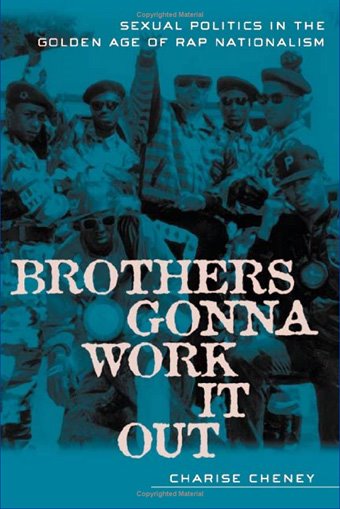
Book Review--Brothers Gonna Work it Out: Sexual Politics in the Golden Age of Rap Nationalism

Brothers Gonna Work It Out: Sexual Politics In The Golden Age Of Rap Nationalism
by Charise L. Cheney
Paperback: 222 pages
Publisher: New York University Press (August 18, 2005)

REVIEW BY TAMI NAVARRO


It is often said that a book should never be judged by its cover. It stands to reason, by extension, that one ought not base one’s judgment on a title, either. However, both the title and cover of Charise Cheney’s recent Brothers Gonna Work It Out: Sexual Politics in the Golden Age of Rap Nationalism accurately reflect the work she does throughout this text. The cover image, a shot of militant beret-sporting black men (including Chuck D and Flava Flav of Public Enemy (for those unfamiliar with this groundbreaking rap group, the latter figure, toting his signature stopwatch around his neck, may be recognized from his recent foray into reality television with the program “Flavor of Love”)—sets the tone for Brothers: an exploration of the masculinist under- (and over-) tones in the world of rap. Moreover, it is important for Cheney’s project that the figures depicted are wearing the sunglasses and berets commonly associated with members of the Black Panther Party (as well as raising their fists in the symbol for “Black Power”), as she goes on to explore the possibilities for politically-aware rap, such as that created by Public Enemy. Finally, Brothers Gonna Work It Out raises questions about the complex relationship between an artist, their art, and the consuming public: What can be expected of rappers? How do they see themselves functioning in various, including political, spheres? How successful are politically-motivated rappers at affecting political change?

Cheney makes the connection between rap and politics clear at the outset of this text by framing her discussion in terms of rap nationalists. Terming politically-sentient rappers like Chuck D “raptivists” (one of the milder attempts at verbal wizardry that make an appearance in this text. “GangstAfronationalist” is among the more far-fetched), Cheney writes that “this book locates ‘raptivism’ within black popular culture and political culture” (Cheney 3). While she represents these ‘raptivists’ as Gramscian organic intellectuals, busily engaged in the work of speaking truth to power, she does recognize the limits of this argument, writing that the inclusion of all rap music under the banner of political “dilutes rap music’s significance as a mode of black cultural expression…and undermines the social authority of those artists whose lyrics explicitly and mindfully engage the issue of black liberation” (Cheney 7). Her project, then, is an engagement with politically-minded rappers during what she understands as rap’s “golden age” (late 1980’s/early 1990’s). I find the beginning chapters of Brothers Gonna Work It Out particularly interesting, as it is here that Cheney lays out her argument and is most clear about the intellectual conversations in which she is engaged. For instance, early on this text she borrows from Paul Gilroy’s work on the black Atlantic and modernity, writing: “born in the school of hard knocks at the crossroads of black Atlantic migrations, rap music is a form of black and urban expression that was forged as a truly New World, or diasporic, music” (Cheney 10).

She goes on to argue that “rap music is a truly pan-American phenomenon, a postmodern example of they type of cultural traffic that has been occurring in the black Atlantic since Africans were first brought to the New World” (Cheney 11). Cheney borrows this notion of the black Atlantic to argue for both the centrality of rap as a traveling art form connecting members of the black Diaspora (a claim about which I am generally wary, as it is a slippery slope toward a quasi-Hersovitsian search for Africanisms in various cultural forms) and its attempt to be simultaneously a cultural and political endeavor. What is most interesting about the former point is her brief engagement with a discussion of what, for lack of better term, I will call ‘diasporic blackness.’ To be fair, she does give a shout-out to the fact that many African-American rap artists have transnational backgrounds (“Many influential hip-hop artists—both DJs and lyricists—are first- or second-generation West Indian immigrants”) yet this casual note seems underdone in light of her broader project of situating rap music as a thread connecting the black Diaspora (Cheney 11).

While Cheney is interested in representing rap music as a point of connection among the African diaspora, her central argument remains the positioning of politically-minded ‘raptivists’ and as such, she goes on to engage in a discussion of the political stance taken by many such artists during “golden age”: black nationalism. Part history lesson, part citation-fest, Cheney uses this section to provide the reader with a working knowledge of (black) nationalism. She cites black nationalists such as Malcolm X who called for the creation of a separate black nation, but herself sides with thinkers such as Wahneema Lubiano, Sterling Stuckey, and Komozi Woodard, who “recommend that definitions of black nationalism go beyond the nation-state configuration and be comprehensive enough to include its cultural manifestations” (Cheney 17). Clearly, the inclusion of cultural forms in a black nationalist platform is central to Cheney’s argument. For her, ‘raptivism’ is often rooted in nationalist ideology. However, it is also the case that nationalism has often worked to silence groups within the nation and downplay their leadership abilities (this has been the case particularly in regard to women). Thus, it comes as no great surprise that the politics of rap music are also problematic in regard to gender.

The third chapter of Brothers Gonna Work It Out, a section which shares its title with the overall work, features Cheney acting as an historian, tracing the historical links between rap music (and its practitioners) and politics. Describing artists such as Chuck D, she writes that “they purposefully invoked the rhetorical and political styling of the Black Panther Party and the Black Power movement of the late 1960’s, complete with its envisioning of black nationalism as a politics of masculine protest…Rap nationalists intentionally conjured a tradition of model, and militant, black manhood” (Cheney 63). She goes on to outline the ways in which raptivists during the ‘golden age’ modeled themselves on political actors such as Marcus Garvey, Malcolm X, and Louis Farrakhan. It is in this section that Cheney’s temporal bracketing (i.e. her single-minded focus on rap during the 1980’s and 1990’s) begins to strike an odd chord: while she is able to make clear the links between culture and politics during this period (a feat accomplished in large part because of her careful contextualization of rap within the larger societal moment defined by issues such as stagflation), her decision not to include more recent artists works to weaken her argument regarding the central importance of the genre. It is true that her final chapter focuses on Mos Def and Talib Kweli (two current hip-hop artists who also perform together in a group known as “Black Star”—a moniker whose political implications are clear to those even fleetingly familiar with Garveyism). However, the fact that this engagement with contemporary hip-hop comes at the end of the text and lasts only a few pages causes Brothers Gonna Work It Out to seem more like a work on the historical particularity of the ‘golden age’ than a treatise on the space where hip-hop and politics meet. In one telling passage, Cheney cites Lord Jamar of Brand Nubian who suggests that “…with rap music a lot of masculine men said, ‘Yeah, this is the way I can sing without singing, and this is a way for me to write poetry without being a poet, like a soft poet.’ And that is why rap is so popular because you can still keep your masculinity” (Cheney 64). This passage, representing rhyming and singing as mutually exclusive for masculine black men calls to mind work done by John Jackson in his recent text, Real Black. In this text Jackson credits, coincidentally enough, Mos Def with bridging this seeming chasm: “Hip-hop polices the borders between singers and rappers quite stringently…Singers are not rappers just as much as the reverse—except when making specific moves to increase the distance between those two forms by crossing that line in recognizably ironic and parodic ways…” However, Jackson goes on to claim that by singing and rapping seriously on his album Black on Both Sides, “Mos Def opens up space for the black, male, hip-hop body to sing itself anew, to destroy the categories of expressive difference that make an authentic male rapper different from an authentic male singer…” (Jackson 187-8). While Cheney does the important work of situating her examples within their broader sociopolitical context, this reader felt that her decision to explore the interstices between rap and politics during the ‘golden age’ make her arguments seem dated: her primary example of someone who transgresses predetermined gender roles she turns to Speech of Arrested Development. Perhaps her introduction of gangsta rap was meant to circumvent this critique, but fails to do so as her discussion centers around artists such as Ice Cube.

There is much to recommend Brothers Gonna Work It Out: Cheney is clearly a capable scholar and hip-hop fan (a combination that makes her text both thoroughgoing and insightful); her style of writing is easily accessible, allowing the reader to follow the ideological course she is plotting, rather than struggle through disciplinary jargon. Further, Cheney does the brave work of outlining fractures within the black community. While she is centrally concerned with inter- gender divisions, she also points to intra- gender complexity, a point most clearly demonstrated in her discussion of the divergent ideological positions taken by Queen Latifah and Sister Souljah in relation to female participation in hip-hop.

In her conclusion entitled “Be True to the Game,” Cheney continues her project of problematizing black nationalism by introducing gender while noting the “continued power of ‘it’s-a-dick-thing’ masculinity and masculinist politicking in U.S. black nationalism” (Cheney 170). In closing Cheney turns to Anne McClintock whose work points to the dangerous silences often produced by nationalism. Toward the end of McClintock’s text, Imperial Leather, she writes: “A crucial question thus remains for progressive nationalism: Can the iconography of the family be retained as the figure for national unity, or must an alternative, radical iconography be developed?” (McClintock 386). Cheney’s contribution is her ability to use rap to skillfully introduce race into the equation such that, for this reader, the question becomes: “Can the black community continue to be understood as a family (or an unproblematized Diaspora), or must this representation be revisited?”

***

TAMI NAVARRO is a Doctoral Candidate in the Department of Cultural Anthropology at Duke University.

Thursday, April 13, 2006

"A Social Disaster" : Voices from Durham--Dasan Ahanu

I was walking down the street and I saw her looking at me kind of strange
A polite hello and she asked if I was the guy at the open mic last week
I said “yeah” and she commented on the words I spoke
She said my poem had a lot of depth, but I didn’t know as much as I thought
See she was a survivor
And though I saw the problem
I lacked the initiative to say what I was going to do about it
She asked if I ever cried of knew the face of pain
If I ever held a scar so deep that I hide it’s presence
Am I willing to examine it and learn the lesson
Confused, I asked her if that is how it feels
She said no,
That’s how you should feel to know they lied to you about what a man should be
And one victim happened to be me
I promised her I would edit my poem and my mind
And have it ready for her the next time…

Lyrics from “Til” by Dasan Ahanu


Behind the Liquid Wall
by Dasan Ahanu

The lyrics to Til were running through my mind as I stood there on Buchannan. I was standing outside amidst a beautiful crowd of people wondering how this continues to happen. We were holding pots and pans and being led by drums in a harmony of noise and protest . Our attention was set on a house occupied by three captains of the men’s lacrosse team at Duke that was the scene of a rape investigation . I was happy to see people who emphatically wanted to see justice served cry out in support of the survivor of the rape, and voice concern over the culture that allows this to happen at Duke, in Durham, in the US, and around the world.

I began to think about the silence the lacrosse team had taken with authorities. I also began to think about an institution like Duke and the impact the assault has on campus. It seemed that there were two worlds intersecting here that shared similar patterns of behavior. I asked myself at what point does loyalty and tradition take a twisted turn. So often a wall is created that protects and preserves both the positive and negative. This wall silences any outcry that wants change or scrutiny of that negative. What does that wall do to accountability? What does that wall do to offset and already unequal power dynamic? What does that wall do to safety and security for all those affected by what it masks? I see it as a wall of liquid bricks. It begins with a false impression of social interaction and enjoyment, is supported by a tradition of tolerance, and chronicled in the tears of so many survivors.

Liquid Courage

Liquid courage: a slang phrase used to refer to any alcoholic beverage. It refers to the fact that many people are more courageous (or, to put it in less optimistic terms, "have less discretion") once they have become intoxicated with alcohol. (en.wikipedia.org/wiki/Liquid_courage)

When I think about the lyrics to Til I am saddened about how men see their masculinity and run from any critical analysis about it. We are so willing to accept the role identified by society and act it out to the fullest. Then in an attempt to run from self-discovery and from the responsibility and accountability that comes with it, we find ways to bypass the fears this avoidance brings.

Social interaction can be difficult for many of us. This is especially true if we are still struggling with our own identity and place in the world. Men are not taught to take any real time to determine who they are. Men are also not encouraged to engage in healthy dialogue or discovery with other men about their identities. With such a narrow understanding of masculinity, interaction with women in a sincere and compassionate way is hard. This is with the full understanding that interactions with queer folks and anyone outside of the gender binary is even harder.

One perceived solution to overcoming the insecurity in social settings is to use alcohol. Alcohol, also know as “liquid courage” can be seen as the way to free the inner you. It reduces inhibitions and encourages risk as the level of consumption greatens. Depending on the tolerance level of the drinker, it may not take much to feel socially adept. Men use alcohol to escape the reservations of insecurity, but also to numb their conscious. What kind of scene does this set? What problems does this create? What danger does this present when balance and privilege of gender is tilted toward men? Now these men have numbed their conscious, set aside their inhibitions, and quieted their moral sensibility. What is the cost?

Men sit and laugh at each other. Often because a guy got “wet” or drunk and woke up with someone he doesn’t know with a vague recollection of what happened. They make jokes and excuse his actions to the alcohol. Other times it’s because they each have stories of wild things a guy did once intoxicated. These stories are of actions that would normally be considered inappropriate, but are excused to the alcohol. When men chronicle the adventures of “liquid courage” in this way, what do you think they will do when the result was an unwanted sexual advance or a rape?

Wet Environment

Wet: supporting or permitting the legal production and sale of alcoholic beverages; "a wet candidate running on a wet platform"; "a wet county"
wordnet.princeton.edu/perl/webwn

This definition describes an environment where alcohol is welcomed and encouraged. Some colleges are environments where alcohol is welcomed and culturally encouraged. The problem with an environment of tolerance is that undergraduates are mostly underage. What kind of environment is created when alcohol is welcome and tolerated in a space where most of the people occupying the space are under the legal age to purchase it. What kind of environment is created when students are able to indulge within the watch of the institution, behind a wall of tradition and entitlement?

I consider that to be a “wet” institution. An institution that considers partying and alcohol to be part of the college experience. It is an institution that would rather attempt to monitor and contain this lifestyle than deny their students their right to party as they choose. Imagine the ramifications if the “wet” institution is one of prestige and affluence, where the students can get access not just to alcohol, but a lot of alcohol. What effect does tolerance have on campus life when students can throw the biggest, most elaborate, and frequent parties they can imagine? Think of how hard it would be to try and change the culture of partying and alcohol on a campus that is lead by fraternal life. Can you imagine the backlash from male alumnus who valued these experiences and relationships so dearly? How could they rob these new young men of that opportunity to make those same memories? How influential do their criticisms sound to male administrators, some also alums, and how influential are their checkbooks?

The statistics are there. You can Google search and see the number of statistics on alcohol and assaults. Most institutions have an alcohol policy and someone on staff to monitor it. Duke’s policy and enforcement of it has become steadily more stringent. Of course, this means that students will become more creative in order to maintain the culture of access that was allowed their predecessors at the University. This includes the prevalence of utilizing the rental properties around campus. Duke University Police and the Durham Police Department have made efforts to crack down on these events, but they still continue. Not only do these parties continue, but each one gets more elaborate than the last.

The Wet Wall

Solidarity: A feeling or condition of unity based on common goals, interests, and sympathies among a group's members
www.fieldsofhope.org/resources/glossary.asp

I was watching a TV special and listening to one man talk about being loyal to his homeboy. He said that he would “ride” with him no matter what, even if his friend had done something stupid. He said he would talk to him afterwards about how stupid the act was, but would stand with him nonetheless. This is a common theme with men. It is the idea that we protect our own, stand in solidarity, and the whole is more important than the one. I think about this self-destructive habit men have as I witness the silence the lacrosse team has taken. It may be dictated by the coaches who are also men. It may be dictated by the University which is led by a man. Yet, it is a male practice that commonly hides indiscretions.

In a 2004 movie called Wall of Silence directed by Christopher Menaul, the tag line was “Do you say anything if you saw anything?”. I found this to be an interesting way to set up a movie where a crime was committed in public eye and no witnesses would step forward. It highlighted the same practice of not saying anything that would harm one of us. It shames me that we would live with this us versus them mentality that would outweigh an atrocious act being perpetrated on another human being. Does the continuum of masculinity go from men don’t cry to men don’t tell?

Tears Fall, a Sad Song Gets Sung

I have to admit I’ve cried and I know the face of pain. I shed tears through my own pain and struggle. I’ve seen the pain on survivor’s faces and on the faces of those who love them. I’ve held a scar so deep that I hide its presence and only through the support and push of strong people in the movement to end the violence have I learned to examine and learn the lesson. I hope that the assault is not a scar that the men on the lacrosse team continue to hide. I hope the assault is not a scar that Duke hides and isn’t willing to learn the lesson.

Tears have been falling in Durham. The community members in the neighborhood around the house where the assault happened have gathered and shed tears. The students who are horrified that this happened have shed tears. Durham has shed tears as it sees the news reports and reads the articles. There is a survivor still shedding tears with her loved ones and children. Other survivors taken back to their own experiences are shedding tears.

There is an interesting fable by Aesop that I feel fits.

A DOE hard pressed by hunters sought refuge in a cave belonging to a Lion. The Lion concealed himself on seeing her approach, but when she was safe within the cave, sprang upon her and tore her to pieces. “Woe is me,” exclaimed the Doe, “who have escaped from man, only to throw myself into the mouth of a wild beast?”
In avoiding one evil, care must be taken not to fall into another.

Imagine the struggle of trying to escape the culture of society as a whole to end up caught in an even worse situation. To have your response to one struggle used as justification to the outcome of the other. To have your pain overlooked and the larger problem ignored. Imagine having to face the fact that the truth is hidden behind a wall of silence.

I just want the wall to come down and a real change to be made.

***

I would like to thank all those who believe in stopping the violence by changing the culture, the survivors and their strength, advocates and activists who push for social change, the women who have showed us how to fight, the queer community who have showed us how to fight, and the ancestors and elders who gave of themselves to stop all oppressions. Thank you to Dr. Mark Anthony Neal, Dr. Jean Leonard, Kevin Powell, NCCASA (www.nccasa.org), NCADV (www.ncadv.org) and Bryan Proffitt and he guys of MARC (http://www.marcnc.blogspot.com/).

Chris Massenburg a.k.a. Dasan Ahanu is a co-founder of Men Against Rape Culture (MARC) and a poet, emcee, activist, organizer, and educator. He can be reached at dasan67@gmail.com.